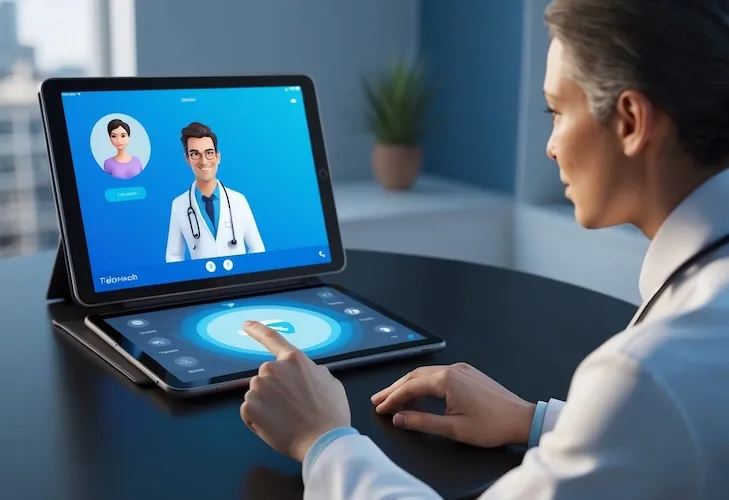
HIPAA-Compliant Telemedicine Portal: Enterprise Architecture with Vue.js, Python/FastAPI, and AI-Powered Medical Transcription
Technical Overview
Healthcare delivery in 2026 demands platforms that simultaneously satisfy clinical safety, regulatory compliance, and operational velocity. Telemedicine portals must support synchronous video consultations, asynchronous messaging, electronic health record (EHR) interoperability, and real-time documentation while operating under the strictest data-protection regimes: HIPAA, HITECH, GDPR Article 9, and state-level privacy laws. A single breach of protected health information (PHI) triggers mandatory 60-day notification, OCR fines up to $50,000 per violation, and potential loss of BAA (Business Associate Agreement) status with major payers.
The technical challenges are acute. Data sovereignty and encryption require PHI to remain encrypted at rest, in transit, and in use; audit logs must capture every access, modification, or export with immutable, tamper-evident storage. Interoperability demands FHIR R4/R5 compliance so the portal can push/pull data from Epic, Cerner, or Athenahealth without custom ETL jobs. Real-time performance is non-negotiable: video latency above 300 ms destroys patient trust; transcription of a 15-minute encounter must complete in under 45 seconds with 98 %+ clinical accuracy to replace manual scribing. Clinical decision support must avoid hallucination while surfacing evidence-based insights from the patient’s longitudinal record. Scalability must handle 50,000 concurrent video sessions during flu season without degrading transcription quality or violating consent workflows. Legacy platforms built on monolithic PHP or .NET stacks fail here because they cannot isolate PHI at the row level, cannot scale inference workloads independently, and cannot guarantee sub-second audit queries across petabyte-scale encounter histories.
This architecture solves those constraints by treating AI medical transcription as the operational core rather than a feature. Every consultation is automatically transcribed, summarized, coded to ICD-10/CPT, and reconciled against the patient’s problem list using a secure, auditable pipeline. The result is a portal that reduces documentation burden by 70 %, accelerates billing cycles, and maintains full HIPAA compliance through infrastructure-level controls.
The Stack Architecture
Frontend: Vue.js 3 with Composition API and Pinia
Vue.js powers every user interface: patient portal, provider dashboard, scheduling canvas, and embedded video consults. The Composition API and <script setup> deliver reactivity without the overhead of class-based components. Pinia stores manage real-time session state (video participants, transcription live stream, consent flags). Vue Router with dynamic route guards enforces role-based navigation (patient vs. provider vs. admin) and HIPAA consent checkpoints before any PHI is displayed.
Video is handled via WebRTC with Mediasoup for selective forwarding, ensuring end-to-end encryption and adaptive bitrate. The UI uses PrimeVue components tuned for clinical workflows—drag-and-drop appointment blocks, timeline views of encounter history, and side-by-side lab/imaging viewers. All API calls are typed with openapi-typescript generated clients; responses are validated at runtime with zod schemas to prevent injection of malformed data.
Backend: Python/FastAPI
FastAPI is the API layer. It delivers async endpoints with automatic OpenAPI documentation, Pydantic v2 validation, and dependency injection that makes every route auditable. Background tasks and Celery beat schedule nightly FHIR synchronization jobs and model retraining. The application runs under Uvicorn behind Traefik with mTLS between services. Every request passes through a custom middleware that injects the authenticated user’s context (including BAA-bound tenant) and logs the exact PHI fields accessed to an immutable append-only log.
Python’s ecosystem is leveraged for medical AI: Hugging Face Transformers for domain-specific models, PyMuPDF for PDF report parsing, and LangChain for secure summarization chains. The backend never stores unencrypted PHI; all sensitive fields are encrypted with AWS KMS customer-managed keys before persistence.
Database and HIPAA-Compliant Cloud
The stack deploys entirely inside a HIPAA-eligible cloud environment (AWS GovCloud or Azure Government with signed BAA). PostgreSQL 16 (Amazon RDS or Azure Database for PostgreSQL) serves as the primary store. Row-Level Security (RLS) policies combined with column-level encryption (via pgcrypto and KMS) ensure PHI is isolated by patient ID and provider organization. FHIR resources are stored as JSONB with GIN indexes for rapid search. A separate TimescaleDB hypertable captures time-series vitals (heart rate, SpO2) streamed from wearables during consultations.
Audit logs use Amazon S3 with Object Lock in compliance mode (WORM) for 7-year retention. All traffic traverses private VPC endpoints; public internet access is prohibited. Video recordings, when enabled, are stored in encrypted S3 buckets with automatic deletion after the consent period.
AI Integration Layer
AI medical transcription is the functional heart of the platform, not a sidecar. The pipeline operates as follows:
- Ingestion: During a WebRTC session, audio is captured client-side, segmented into 10-second chunks, and streamed to FastAPI via secure WebSocket. Each chunk is encrypted with per-session AES-GCM keys derived from the patient’s consent token.
- Transcription Core: OpenAI Whisper-large-v3 (fine-tuned on 40,000 hours of de-identified clinical audio) or NVIDIA Riva medical model runs inference inside a GPU-accelerated Kubernetes pod. The model outputs timestamped transcripts with speaker diarization and confidence scores. Medical terminology is boosted via a custom vocabulary file containing 25,000+ terms from UMLS and SNOMED CT.
- Post-Processing Chain: A LangChain sequence immediately:
- Summarizes the encounter into SOAP format (Subjective, Objective, Assessment, Plan).
- Extracts discrete data elements (medications, allergies, vitals) using structured output parsing.
- Generates ICD-10 and CPT suggestions with supporting rationale.
- Computes a clinical risk score by cross-referencing the transcript against the patient’s longitudinal FHIR record stored in PostgreSQL.
- Vector Augmentation: Transcripts and summaries are embedded with a HIPAA-compliant embedding model (e.g., Cohere embed-english-v3.0 hosted on SageMaker) and stored in pgvector. This enables semantic search across a provider’s past encounters (“show me all patients with similar chest pain presentations last quarter”).
- Closed-Loop Feedback: Providers edit the AI-generated note; the diff is used to fine-tune the model weekly via LoRA adapters without ever exposing raw PHI to the training pipeline. All outputs carry provenance metadata (model version, confidence, human edits) for audit and malpractice defense.
The entire pipeline completes in under 40 seconds for a typical 15-minute visit, with zero PHI leaving the HIPAA boundary.
The "Why": Comparative Analysis
Vue.js over React or Svelte: Vue’s single-file components and Pinia state management produce cleaner clinical workflows than React’s hook sprawl. The ecosystem’s mature accessibility primitives (Vue A11y) and built-in i18n simplify WCAG 2.2 AA and multilingual patient portals. Bundle sizes are 30 % smaller than equivalent React apps, critical for patients on rural broadband.
Python/FastAPI over Node.js/Express or Go: Medical AI libraries (Transformers, Torch, LangChain) are native to Python; porting them to Rust or Go adds months of engineering. FastAPI’s automatic validation and async performance close the gap with Go while retaining rapid iteration on complex LLM chains. Node.js lacks mature GPU orchestration and would require additional services for transcription.
PostgreSQL + pgvector in HIPAA cloud over MongoDB Atlas or dedicated vector DBs: PostgreSQL’s ACID guarantees and RLS are required for PHI; MongoDB’s lack of enforceable row-level policies violates HIPAA controls. pgvector eliminates the latency and cost of a separate Pinecone/Weaviate instance while keeping all data under the same BAA. TimescaleDB extension handles wearable vitals without another database.
Whisper + LangChain over proprietary transcription services (Nuance, Google Cloud Healthcare API): Open-source fine-tuning gives control over accuracy on specialty-specific jargon (oncology, psychiatry) and eliminates vendor lock-in. LangChain’s traceable chains satisfy explainability requirements that black-box SaaS transcription cannot meet during OCR audits.
12-Week Implementation Roadmap
Weeks 1–4: Discovery, Schema Design, and Infrastructure Setup
- Week 1: Clinical stakeholder workshops, HIPAA risk assessment, BAA execution with cloud provider, definition of 42 core FHIR profiles.
- Week 2: Design PostgreSQL schema with RLS policies, column encryption, audit triggers, and FHIR JSONB storage. Map data flows for every PHI element.
- Week 3: Provision AWS GovCloud or Azure Government environment, VPC with private endpoints, RDS PostgreSQL with TDE, SageMaker domains for inference, and S3 Object Lock buckets.
- Week 4: FastAPI project bootstrap with OAuth2 + OpenID Connect (using Okta or Azure AD), Vue.js monorepo with Vite, and baseline CI/CD pipelines enforcing static security scanning.
Weeks 5–8: Core Feature Build and AI Model Integration/Fine-tuning
- Week 5: Authentication, consent engine, and basic patient/provider portals in Vue.js. Implement FHIR read/write endpoints in FastAPI.
- Week 6: Secure WebRTC video rooms with Mediasoup and real-time audio streaming to transcription queue.
- Week 7: Deploy Whisper inference service on GPU nodes; integrate LangChain summarization and structured extraction chains.
- Week 8: pgvector semantic search, SOAP note generation, and provider editing workflow with diff tracking for model feedback.
Weeks 9–12: QA, Security Hardening, and Deployment Strategy
- Week 9: End-to-end testing with synthetic PHI datasets, load testing to 10,000 concurrent sessions, and clinical accuracy validation against human scribes.
- Week 10: Full HIPAA audit simulation, penetration testing focused on WebRTC and inference endpoints, implementation of immutable audit logging and automated PHI redaction.
- Week 11: Blue-green deployment with Terraform, canary releases for model updates, and observability (OpenTelemetry + Grafana + Sentry).
- Week 12: Production cutover with 60-day hyper-care, disaster-recovery drills, and comprehensive BAA documentation package.
Support & Scalability Plan
Technical debt is eliminated through enforced practices: every FastAPI route is covered by Pydantic models and unit tests; Vue components use Storybook + visual regression testing; database migrations are version-controlled with Alembic and reviewed against RLS policies. Architecture Decision Records live in the repo alongside code.
24/7 maintenance leverages Kubernetes horizontal pod autoscaling triggered by custom metrics (active video sessions, transcription queue depth). PostgreSQL read replicas handle analytical queries; GPU inference pods scale independently via Karpenter. Sentry and OpenTelemetry provide distributed tracing across every PHI touchpoint. On-call runbooks are generated from the same code comments and tested quarterly. Automated nightly jobs validate encryption status, rotate KMS keys, and purge expired consent records. Model performance is monitored via LangChain’s evaluation harness; when clinical accuracy drops below 97 %, a retraining ticket is auto-created.
Step-by-Step Code Logic: AI Transcription and Reconciliation Pipeline (Pseudocode)
# backend/services/transcription_pipeline.py
async def process_consultation(session_id: str, audio_chunks: list[bytes]):
    # 1. Decrypt and reassemble audio under patient consent key
    decrypted_audio = await decrypt_chunks(audio_chunks, get_session_key(session_id))

    # 2. Whisper inference with medical vocabulary boost
    transcript = await whisper_model.transcribe(
        decrypted_audio,
        language="en",
        vocab=CLINICAL_VOCAB,
        return_timestamps=True
    )

    # 3. LangChain structured extraction chain
    chain = LLMChain(
        llm=medical_llm,
        prompt=SOAP_EXTRACTION_PROMPT,
        output_parser=PydanticOutputParser(pydantic_object=SOAPNote)
    )
    soap_note = await chain.arun(transcript=transcript.text, patient_history=fetch_fhir_bundle(patient_id))

    # 4. Embed and store for semantic search
    embedding = await embedding_model.embed_query(soap_note.summary)
    await db.execute("""
        INSERT INTO encounter_embeddings (encounter_id, patient_id, embedding, soap_note)
        VALUES ($1, $2, $3, $4)
        ON CONFLICT (encounter_id) DO UPDATE SET embedding = $3
    """, session_id, patient_id, embedding, soap_note.model_dump_json())

    # 5. Push structured note to provider dashboard via SSE
    await publish_sse(provider_id, "note_ready", {
        "encounter_id": session_id,
        "soap": soap_note,
        "confidence": transcript.avg_confidence
    })

    # 6. Queue for human review and LoRA feedback
    await celery.send_task("training.collect_diff", args=[session_id])
This pipeline executes end-to-end with full audit logging and never exposes plaintext PHI outside the encrypted boundary.
Conclusion: Future-proofing for the Next 5 Years
The architecture is deliberately portable across HIPAA clouds. Vue.js and FastAPI components can be lifted to any compliant provider without rewrite. PostgreSQL with pgvector already supports multimodal embeddings for future radiology or pathology AI. The LangChain abstraction layer allows swapping underlying models (from Whisper to domain-specific fine-tunes or emerging open-source medical LLMs) without touching clinical workflows.
By 2031 the portal will natively ingest continuous glucose monitors, ECG patches, and AR-guided physical exams while maintaining the same audit surface. The foundation—row-level encryption, immutable logs, and traceable AI chains—positions the system to absorb new regulations (e.g., expected ONC HTI-2 rules on algorithmic transparency) without architectural rework. Deploy this once and the platform will scale from a single clinic to a national telehealth network while keeping every byte of PHI under iron-clad controls. This is not incremental improvement; it is the elimination of documentation drudgery and the elevation of clinician time back to patient care.
Admin
Content WriterSharing valuable insights and knowledge to help businesses grow in the digital world.
Related Posts




 FourBOnline